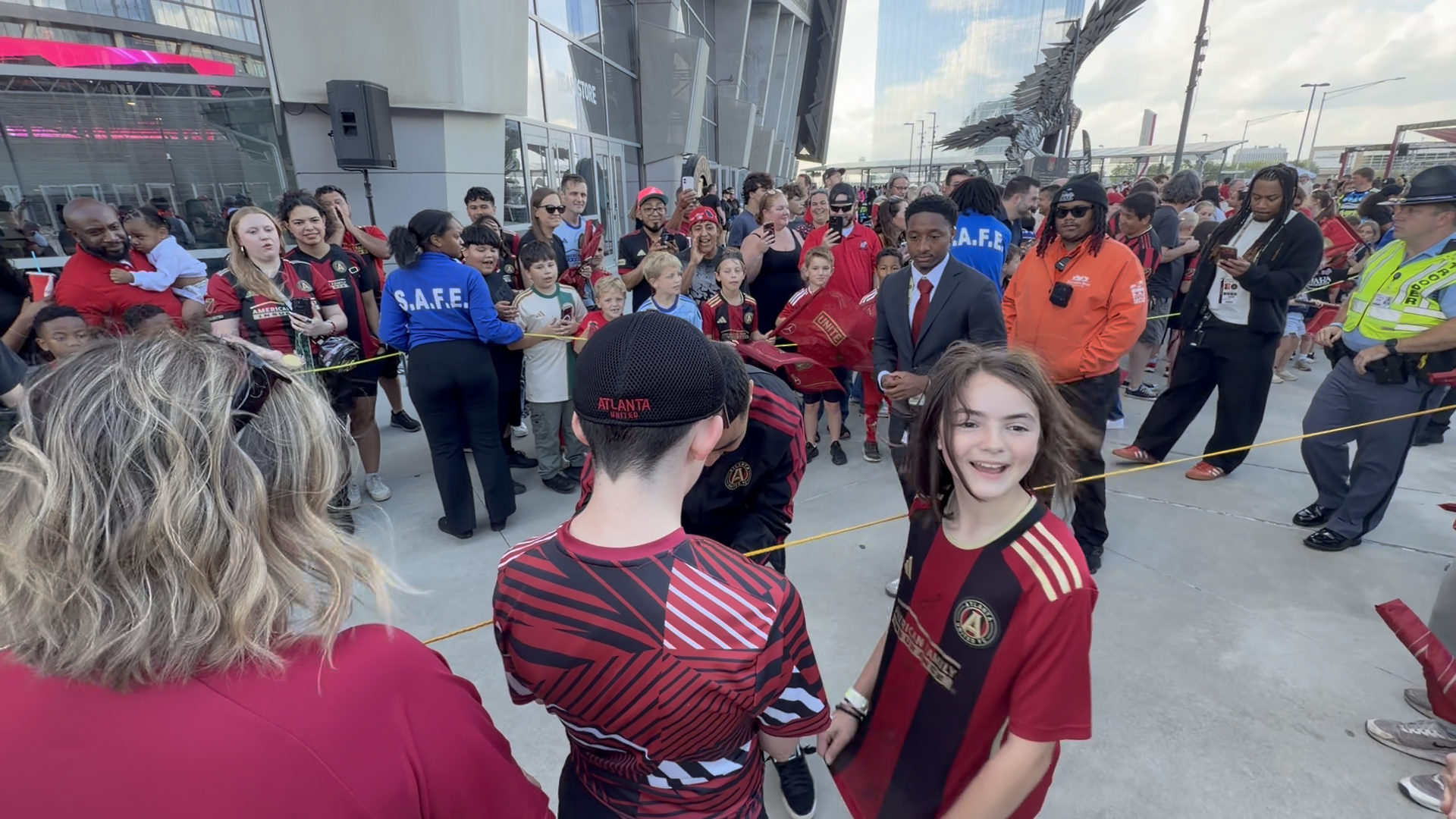
Last week, my family and I went to an Atlanta United game, and before kickoff we somehow got pulled aside and asked if we wanted to help carry one of the large flags onto the field during the national anthem. We said yes, and a few minutes later we were being ushered down into the tunnel with a few hundred other people, none of whom had done this before and none of whom were given anything resembling a rehearsal or walkthrough.
There was a woman standing in front of us giving instructions, and what stood out to me was how little she actually said.
What That Looked Like
She didn’t try to explain the whole sequence or walk us step by step through what was about to happen. Instead, she gave us two very specific cues to listen for.
When the crowd finished the “A-T-L” chant—on the “T”—we were to unfurl the flag.
And when the national anthem ended on “brave,” we were to refurl it and head off the field.
That was the entirety of the instruction.
What Happened Next
What followed was exactly what you would hope for, but not necessarily expect given the circumstances. A few hundred people who had never met each other, had never practiced this, and had only been given those two instructions all moved at the same time, at the right time, without hesitation or confusion.
No one stopped to ask what they were supposed to do, and no one seemed unsure about when to do it.
There were a few people who weren’t fully paying attention, which you’d probably expect in a group that size, but what stood out was how quickly others stepped in. You could hear people calling out reminders, helping coordinate, and making sure everyone around them stayed in sync.
It wasn’t organized. No one was assigned to do that. But people took ownership of the small piece they were responsible for and helped keep things aligned.
Why It Worked
The reason it worked felt obvious once you saw it play out.
She didn’t give us something new to remember. She anchored what we needed to do to something we already knew.
Everyone in that stadium knows the ATL chant. It’s not something you have to think about or recall—you just recognize it when it happens. The same is true for the end of the national anthem. When you hear that final word, you know the moment has arrived.
By tying the action to those signals, she removed the need for memory entirely and replaced it with recognition.
That distinction is small, but it matters.
Where This Shows Up at Work
In most organizations, coordination tends to lean heavily on explanation. We document the steps, we walk through the process, we send reminders, and then we follow up again when things don’t happen the way we expected.
The assumption is that if people just had a little more clarity—or a little more repetition—they would execute more consistently.
But what I saw on that field suggests something different.
The issue often isn’t that people don’t know what to do. It’s that the moment to act isn’t clearly defined in a way they can recognize without thinking about it.
When execution depends on someone pausing to recall instructions, even briefly, it introduces friction. Sometimes that friction shows up as hesitation. Sometimes it shows up as inconsistency. Sometimes it just shows up as work not getting done.
On that field, there was no need to pause. The moment arrived, and everyone responded.
What This Reminds Me Of
You can’t always simplify the work itself, but you can make the signals clearer.
You can anchor actions to something people already understand—something they will recognize in real time rather than something they have to remember after the fact.
That’s what made that experience work, and it’s part of why it stood out to me more than I expected it to.
And beyond all of that, it was just a really cool moment.
I love soccer, and standing there on the field, holding that flag—on the same pitch where some of the best players in the world will be playing soon—was absolutely a joy.